“UNESCO and Huawei to Support Smart Classrooms in Sri Lanka”: PM – should This be The Real Priority?

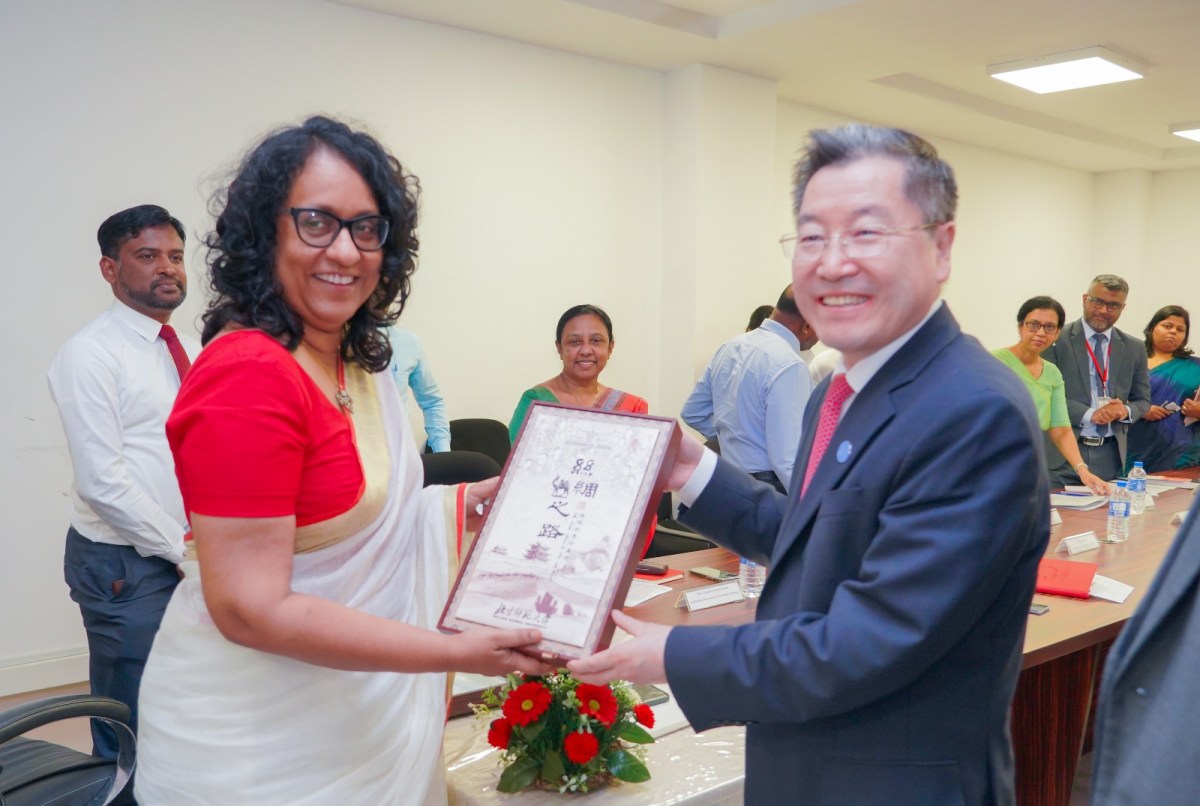
Speaking during a discussion held recently at the Ministry of Education with representatives from Huawei Technologies and the UNESCO International Research and Training Centre for Rural Education (UNESCO-INRULED), the Prime Minister Dr. Harini Amarasuriya emphasized the need to use foreign educational assistance in the most effective manner for the wellbeing of students.

She stated that the Ministry of Education and the Digitalisation Task Force should jointly launch a coordinated programme to ensure that digital equipment, including interactive display panels required for smart classrooms, is distributed systematically and equitably among schools. Special attention, as she noted, must be given to rural areas to reduce educational disparities.

This evidently signals a clear intention to modernise classrooms, particularly in rural areas. Interactive screens, smart classroom tools, and teacher training programmes are being positioned as key solutions to bridge long-standing educational gaps. On paper, it sounds like progress. But an important question remains: are digital tools what Sri Lankan classrooms need most right now?

There is little doubt that technology can enhance learning when used thoughtfully. Interactive displays can make lessons more engaging, digital content can widen exposure, and trained teachers can use technology to explain complex concepts more effectively. For rural schools that have long been under-resourced, such initiatives also represent recognition and long-overdue attention.

Yet, the reality inside many classrooms tells a more complicated story.

Across the country, thousands of students still struggle with basic access to textbooks, libraries, and reading materials. In some schools, book shortages persist and reading corners are nonexistent. For younger students especially, foundational learning depends less on screens and more on books they can hold, reread, annotate, and truly engage with because literacy, comprehension, and critical thinking are still built page by page.

This raises a critical concern: does introducing advanced digital equipment risk addressing the future before securing the basics?

Digital tools are only as effective as the systems that support them. Maintenance, internet access, and trained teachers and technical staff are not evenly available across schools. Even with teacher training underway, the long-term sustainability of smart classrooms depends on continuous funding, technical support, and clear usage policies. The education system is still learning to manage these challenges.

The government’s emphasis on child safety frameworks and age-appropriate digital use is a welcome and necessary step. It acknowledges global concerns around screen time, distraction, and digital dependency. Still, regulation alone cannot replace the deep learning that comes from quiet reading, sustained attention, and access to quality printed material.

This does not mean Sri Lanka should turn away from digitalisation. Rather, it suggests the need for balance. Technology should complement education, not overshadow its foundations. A smart classroom without books risks becoming a visually impressive space that lacks depth. Conversely, a classroom rich in books but supported by selective, purposeful technology may offer students the best of both worlds.

As foreign-funded digital initiatives move forward, policymakers may need to ask a simpler, student-centred question:
Are we building classrooms that look modern or classrooms that help children learn better?

True educational progress may lie not in choosing between screens and books, but in ensuring that every child and teacher first has access to the essentials, before being introduced to the extras.


Top Misconceptions About Choosing a Master’s Degree

Choosing a master’s degree is a major step toward building your future but too many students make decisions based on myths instead of facts. These misconceptions can lead to picking the wrong programme, wasting time, or missing out on better opportunities. Check out these misunderstandings and find the truth behind them so you can make a smarter choice.

1. “Any Master’s Degree Will Guarantee a Better Job”

Almost everyone thinks that simply having a master’s degree means you’ll automatically get a better job but in reality, a postgraduate degree can improve your employment prospects but only if it’s relevant to your career goals and industry demands. Employers look at the skills you bring, not just the title of your degree. Choosing a course that matches your career path and equips you with practical skills is far more important than the degree itself.

2. “Prestigious Universities Are Always the Best Choice”

The misconception is that more prestigious names equal better programmes whereas in reality, reputation is important, but it isn’t everything. A top-ranked university may have limited options in your specific area of interest. In contrast, a lesser-known institution might offer excellent training, closer mentorship, or stronger industry connections in your field. What matters most is fit; not brand name.

3. “A Master’s Degree Is Only for Academics”

Misconception: Master’s degrees are only for people who want to become researchers or lecturers.

Reality: Postgraduate study benefits a wide range of professionals. Many master’s programmes focus on industry-ready skills, real-world projects, internships, and professional networking. Whether you want to become a specialist, move into management, or switch careers, the right master’s degree can help.

4. “You Must Know Your Career Path Before Applying”

If you’re not 100% sure about your career, you shouldn’t pursue a master’s. People might repeat this for a while but time will say, it’s good to have direction, but you don’t need a perfect roadmap.

Masters programmes often help you clarify your goals and explore new areas. What matters is picking a subject that genuinely interests you and builds useful skills. You can refine your exact career focus later.

5. “Online Degrees Are Less Valuable”

Misconception: Online or distance learning isn’t as respected as on-campus study.

Reality: Today, many online programmes are developed by top universities and accredited in the same way as campus degrees. What matters is accreditation, quality of curriculum, and learning outcomes, not delivery mode. Online degrees can be especially valuable if you need flexibility while working or managing other commitments.

6. “Higher Cost Means Higher Quality”

People have misunderstood that expensive tuition means a better degree but while quality programmes sometimes cost more, price alone doesn’t guarantee value. Scholarships, funding opportunities, and lower-cost programmes can offer excellent education and outcomes. What counts is return on investment; the skills, networks, and opportunities you gain from the programme.

7. “You Must Choose a Programme That Matches Your Bachelor’s Major”

Misconception: You can only do a master’s in the same field as your bachelor’s.

Reality: Many postgraduate degrees accept students from diverse academic backgrounds. For example, business, IT, psychology, and education programmes often welcome interdisciplinary applicants. Changing fields is possible; as long as you can demonstrate interest, aptitude, and a clear reason for the switch.

Choose Strategically, Not Emotionally

A master’s degree is a significant investment of time, money, and effort. Don’t let misconceptions shape your choice. Instead, you can focus on your career goals, the real strengths of each programme, the skills you’ll gain and how they apply to your desired path and accreditation and industry recognition.

Making an informed choice today can set you up for success tomorrow.

Sources: Should I do a Masters?

While you’re at it, check out our recent article:

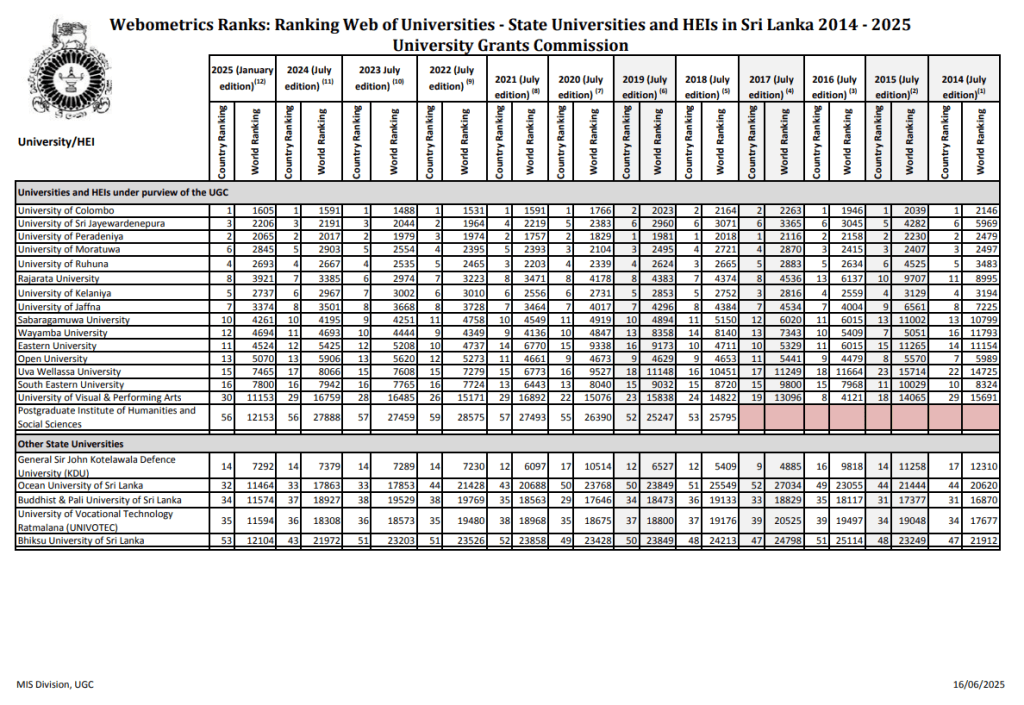
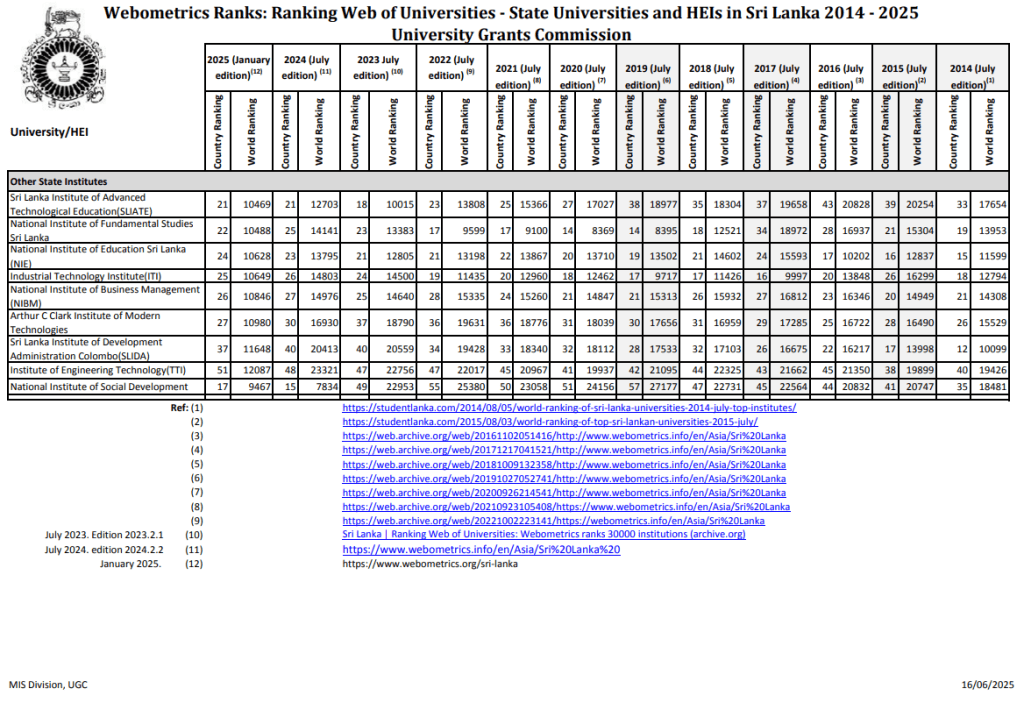
University Rankings in Sri Lanka 2025: Who’s Leading the Pack?

Choosing a university today isn’t just about tradition or reputation; it’s also about global visibility, research impact, and digital presence. According to the Webometrics Ranking of World Universities (January 2025 edition), Sri Lankan universities continue to compete on an international scale, with several institutions standing out nationally and globally.

Webometrics evaluates universities based on web presence, research excellence, transparency, and impact, making it a useful indicator of how well universities perform in the digital and academic space.

Top-Ranked Universities in Sri Lanka – 2025

Based on the January 2025 Webometrics rankings, the leading universities in Sri Lanka are:

Sri Lanka is Talking about Banning Phones and Social Media for Kids

Sri Lankan government is exploring the possibility of restricting smartphone use and social media access for children, especially those under 12 as part of a broader effort to protect minors from harmful online content. The proposal has been officially discussed by senior cabinet members, though no final law has been passed yet.

The concern is pretty simple: children are spending more time online than ever before, and not all of it is healthy. The content children are exposed to is not only harmful but also abusive with unethical, immoral and inappropriate online materials all the while impacting child development and safety.

One reason for the government to discuss this issue comes amid a global trend of countries tightening rules in children’s access to digital platforms.

Australia has “rightfully” implemented a ban on social media (SM) for those under 16, France moved to ban SM use by children under 15 and other governments, including India are debating age-based limits or parental controls.

While many believe banning smartphones is the right step, some feel smartphones are part of everyday life. They argue that instead of bans, children need guidance, better rules, and digital education to help them use technology responsibly.

For now, it’s still just a conversation with no confirmed bans but what we, as the younger generation of the country, can see is that Sri Lankan government is trying to figure out where to draw the line between protection and freedom in a digital world.

Doomsday Clock 2026: What the “85 Seconds from Midnight” Really Means for the World

The Doomsday Clock has been set to 85 seconds to midnight which is the closest it’s ever been since it was introduced in 1947, signaling rising global risks and existential threats.

Let’s get into simple terms. The Doomsday Clock isn’t a countdown timer in the usual sense because it doesn’t tick down in real time like the usual clocks do and it doesn’t precisely predict the moment the world will end. But when scientists say we are 85 seconds to midnight, it is hard not to pause and feel uneasy.

What does the midnight represent? Midnight in this case represents global catastrophe or a point where human-made threats like war, climate collapse, technology and pandemics overwhelm our entire abilities to control them. What’s more concerning is that being this close has never happened before. According to the scientists behind the Doomsday Clock, we are closer to disaster than any point in modern history.

This 85 seconds is symbolic and not literal. It doesn’t mean that the world ends in 85 seconds; rather it represents how compressed the margin for error has become. In simple terms, we no longer have the luxury of time to reverse our mistakes. We had time before, but now, we don’t anymore.

One reason the clock moved closer this year, 2026, is because, as experts have pointed out, a dangerous mix of problems is occurring all at once. This is indeed true because today, nuclear tensions remain as high as ever (especially with diplomatic trust becoming more fragile), climate change is advancing rapidly, biological risks including pandemics remain a real threat almost every day and international cooperation is weakening, particularly when it is needed the most.

These not only say that individually, these risks are serious but also together, they amplify each other.

This clock is not saying, “it’s over.” But it’s definitely saying, “this is the moment to act.” The closer the clock gets to midnight, the louder the warning becomes. The scientists state that it is possible to move the clock back but it solely depends on human choice rather than fate.

We may not know how soon things could unravel but one thing is sure now: the time to fix what’s broken is now, not later.

Sources: Doomsday Clock 2026: Scientists set new time

Want to find out how technology has rewritten childhood? Read:

Kids Swiping Books Like Phones: Losing Childhood to Technology

Imagine a child picking up a storybook and trying to swipe the page like it’s a smartphone screen. This moment actually reveals something real about how technology has shaped the way the youngest generation interacts with the world.

A recent survey of primary school teachers in the UK found that nearly one in three kids just starting school didn’t intuitively use a book the traditional way and some even reached out to tap or swipe paper pages as if they were digital screens.

Why Phones First and Books Second?

This is not just a silly misunderstanding. it reflects how deeply smartphones and tablets are woven into kids’ early lives. Many children today have grown up surrounded by touchscreens, voice assistants, and apps that respond instantly to every gesture. So it’s almost unsurprising that a curious preschooler might expect a book to “work” the same way.

The survey didn’t just look at book handling. It also showed that some children are arriving in school without what used to be considered basic “school-ready” skills like eating independently, drinking from a cup confidently, or using the toilet on their own.

Some early childhood research links heavy screen exposure at a very young age with delays in things like language, social interaction, and fine motor development, the kinds of skills you would normally build by interacting with books, puzzles, and peers.

Other studies have suggested that when children have more devices in the home, they actually read less by choice, especially in unrestricted screen environments.

This isn’t to say technology is inherently bad. Many parents and educators find digital tools valuable when used thoughtfully. But when screens become the default way to interact, children may sometimes miss out on the early physical and social learning experiences that books, play, and face-to-face conversation encourage.

Some schools are now experimenting with changes like phone-free classrooms or less emphasis on digital devices during early years so that children can develop focus, curiosity, and interpersonal skills without constant screen stimulation.

Parents, too, are encouraged to balance screen time with old-fashioned play, reading together, and letting kids explore the world with their hands and senses, not just their fingertips.

This isn’t just a funny story about kids and their gadgets. It’s a small snapshot of a larger cultural shift: Technology is reshaping childhood and that shift shows up in how kids learn to interact with even the simplest things like a book.

Whether we see it as adaptation, disruption or both, it’s worth paying attention to what kids are learning first and how that shapes how they see the world.

Sources: Children Starting School Are Trying to Swipe Books Like They’re Phones

Related Read:

New Universities Act Explained: What Sri Lankan Undergraduates Really Need to Know

When Parliament passed the latest amendments to Sri Lanka’s Universities Act, many students started wondering if this was political and if it will affect their degrees, lecturers or campus freedom.

According to Prime Minister and Minister of Education, Higher Education and Vocational Education, Dr. Harini Amarasuriya, the answer is clear: this change is not meant to politicise but depoliticise universities.

What does this actually mean for undergraduates and what was changed in the Universities Act?

The amendments mainly focus on how academic leaders are chosen, especially Deans and Heads of Deparmtments (HoDs). Previously, only a narrow group of senior academics could be appointed as Deans but today, senior professors, professors, associate professors and senior lecturers (Grade I) are eligible.

Most Importantly, Deans will now be appointed by the faculty board, not imposed from outside.

The Minister also highlighted the term limits for Deans. A Dean can serve only two terms maximum and no one can hold the position indefinitely.

Limits on Heads of Departments are that a person cannot be Head of the same department for more than one term and no one can hold the HoD position for more than two consecutive terms. This encourages leadership rotation and fairness.

Why this is a Big Change is because in the past, leadership appointments were often criticised for being politically influenced, Top-down decisions and resistant to change. But under this new system, faculty members choose their own leaders, leadership becomes more democratic and transparent and political influence is reduced.

“Med School Is ‘Pointless’? Elon Musk Says Robot Surgeons Could Eclipse Human Docs Soon”

Elon Musk has ignited a fresh firestorm over the future of healthcare after telling the Moonshots podcast that traditional medical school could soon be obsolete; thanks to AI-powered robots taking over surgery and other medical duties.

Speaking with host Peter Diamandis, the billionaire founder of Tesla, SpaceX and Neuralink laid out a bold and controversial timeline. Musk claimed that autonomous, AI-driven robots like Tesla’s humanoid Optimus could outperform the best human surgeons “at scale” within just three years.
When Diamandis asked whether aspiring doctors should skip medical school, Musk didn’t mince words: “Yes. Pointless.”

Musk’s argument centers on three big points. One is that he says that it takes years of grueling study and practice to become a surgeon butt robots, powered by AI and machine learning, can learn rapidly and share insights instantly.

    He also highlights that AI doesn’t get tired or shake under pressure, properties Musk says are vital for top-tier surgery. Musk also predicts “more Optimus robots that are great surgeons than there are all surgeons on Earth” by around 2030.

    He also pointed to Neuralink’s surgical robot, which is already used to implant ultra-thin electrodes into the human brain with precision far beyond human hands, a real-world example of machine superiority in delicate procedures.

    Make Your Research Cinematic and Let It Defend Itself

    For many research students, the biggest challenge is not conducting research, but communicating it clearly. Strong findings can lose their impact if they are presented in a way that feels confusing, distant, or overly technical for observers.

    One effective way to avoid this is by using storytelling techniques in academic communication. This does not mean exaggeration or simplification of facts. Instead, it is about structure, clarity, and engagement.

    Why Storytelling Matters in Research

    Research is often shared with audiences beyond your supervisor. Audiences such as conference attendees, reviewers, policymakers, journalists, and the public are more likely to understand and remember your work when it follows a clear narrative and having a clear narrative will help you:

    • Clarify your research purpose
    • Show the importance of your research problem
    • Guide readers logically through your work
    • Make complex ideas easier to follow

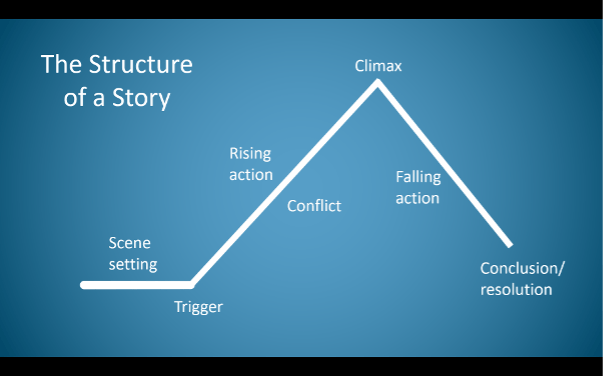
    Most successful research papers already follow a story-like structure, even if we do not always recognize it. You can think of your research as having the Classic Story Arc.

    A strong story has:

    • Scene-setting: Where are we? What’s the context?

    • Trigger: What problem kicked things off?

    • Rising Action: The hard work: experiments, challenges, data collection.

    • Conflict: What got in your way? Tough data? Unexpected results?

    • Climax: Your breakthrough moment.

    • Resolution: What your findings mean for the world.

    Image credits: Turn your research into a Hollywood-worthy story

    This arc fits any research field: your literature review is the setup, methodology and data collection become the adventure, and your conclusions are the satisfying finish.

    Viewing your research this way can help you explain it more confidently and coherently and ultimately will help the audience grasp a clear idea.

    In order for this to work, you should keep your language simple and not complicated. Using complex language does not make research stronger. Clear writing shows clear thinking. While technical terms are sometimes necessary, they should be used carefully and explained when possible.

    That said, it is necessary to ditch academic jargon because only straight-forward language can help anyone follow your story and make them curious to know what will happen next.

    You can ask these questions yourself to understand this more:

    • Would a student from another discipline understand this section?
    • Can this sentence be shorter or more direct?

    If you think this way, your research’s clarity will increase both its accessibility and credibility.

    Storytelling is especially useful when:

    • Writing conference abstracts
    • Preparing presentations
    • Explaining your research to non-experts
    • Writing blog posts or summaries about your work

    A well-told research story makes your work easier to share, publish, and promote.

    Learning to frame your research as a structured story does not reduce or cheapen its academic value. Instead, it amplifies its impact and ultimately helps your ideas travel further and reach the audiences they deserve. For research students, storytelling is not an optional skill, it is a powerful tool for academic success. So make sure you grab your audience from the first line and take them on a research journey worth remembering.

    Sources: Turn your research into a Hollywood-worthy story

    How to Get Japan’s MEXT Teacher Training Scholarship 2026 (Complete Guide)

    For teachers who dream of improving their teaching skills while experiencing a new culture, the Japanese Government’s MEXT Teacher Training Scholarship offers a valuable opportunity. Designed for teachers from overseas, this program allows you to study in Japan and gain exposure to advanced educational methods while building international academic connections.

    The scholarship is funded by Japan’s Ministry of Education, Culture, Sports, Science and Technology (MEXT) and is specifically aimed at in-service teachers who wish to enhance their professional skills. Selected candidates will be enrolled in Japanese national universities, where they will focus on teacher training rather than degree-oriented study.

    Embassy Request & Application Process

    • The Embassy respectfully requests the Ministry, in coordination with the Ministry of Education, to:
      • Select suitable candidates for the MEXT Scholarship
      • Follow the attached Application Guidelines
      • Choose candidates from teachers who wish to conduct research on school education

    1. Screening & Examination

    • Applicants will first go through the First Screening conducted by the Embassy.
    • Shortlisted applicants will then attend:
      • A written examination (subjects: Japanese and English)
      • Interviews
    • The written exams and interviews will be jointly conducted by:
      • The Embassy
      • Ministry of Foreign Affairs
      • Ministry of Education
    • Date of exams and interviews: 20th February 2026

    2. Submission of Documents

    • The Ministry is requested to:
      • Submit application forms and all required documents as stated in the Guidelines
      • Send them to the Embassy by 30th January 2026

    3. Nomination of Interview Officers

    • The Ministry is also requested to:
      • Nominate officers to serve on the interview panel
      • Officers should be from:
        • Ministry of Foreign Affairs
        • Ministry of Education

    Qualifications and Conditions (MEXT)

    MEXT accepts international students who meet the following requirements.
    The goal is to develop people who strengthen friendship between Japan and their home country and contribute to global development.

    1. Nationality

    • Applicants must be citizens of a country that has diplomatic relations with Japan.
    • Applicants cannot have Japanese nationality at the time of application.
    • Applicants with dual nationality (including Japanese) may apply only if:
      • They live outside Japan at the time of application
      • They choose their non-Japanese nationality
      • They renounce Japanese nationality before arriving in Japan
    • The first screening must be done at the Japanese embassy of the chosen nationality.

    2. Age

    • Applicants must be born on or after April 2, 1991.
    • Exceptions are allowed only if MEXT accepts that the applicant could not apply earlier due to:
      • Military service
      • War or conflict
      • Loss of educational opportunities due to national circumstances
    • Personal reasons (money, family, health, job, or university issues) are not accepted for age exceptions.

    3. Academic and Career Background

    Applicants must:

    • Be graduates of a university or teacher training school
    • Have at least 5 years of teaching experience by October 1, 2026
      • Teaching must be at:
        • Primary schools
        • Secondary schools
        • Teacher training institutions (excluding universities)
    • University faculty members are not eligible.

    4. Japanese Language Ability

    • Applicants must be willing to learn Japanese.
    • Applicants must:
      • Be interested in Japan
      • Be willing to understand Japanese culture and society
      • Have the ability to conduct research
      • Be able to adapt to life in Japan

    5. Health

    • Applicants must submit a medical certificate in the official format.
    • The certificate must be signed by a doctor.
    • It must confirm that the applicant has no physical or mental conditions that would prevent study in Japan.

    6. Arrival in Japan

    • Applicants must arrive in Japan during the designated period (usually September or October).
    • Arrival must be:
      • No earlier than two weeks before the course starts
      • No later than the course start date
    • If the applicant cannot arrive during this period for personal reasons:
      • Travel expenses will not be provided
    • If the applicant cannot arrive by the end of the specified period:
      • They must withdraw from the scholarship
      • Unless MEXT accepts the reason as unavoidable

    comprehensive financial support

    • After arrival in Japan, 143,000 yen per month will be paid.

    • A supplemental regional allowance of 2,000 or 3,000 yen per month will be added to the monthly scholarship amount for the grantees studying or conducting research in specially designated regions. Due to the situation of the Japanese Government’s budget, the amount of payment may be subject to change each fiscal year If a grantee is absent from the university for an extended period, the scholarship shall be suspended for that period.

    • Education Fees: Fees for the entrance examination, matriculation and tuition at universities are weaved.

    Travel Expenses

    1. Travel to Japan

    • MEXT provides one economy-class airline ticket to Japan.
    • The ticket is from the nearest international airport to your residence (usually in your home country) to Japan, using a normal route.
    • MEXT decides the travel schedule and route.

    2. Costs you must pay yourself

    You must cover these expenses on your own:

    • Travel from your home to the nearest international airport
    • Airport taxes and airport usage fees
    • Special travel taxes
    • Travel costs within Japan (including domestic flights)
    • Travel insurance
    • Extra baggage or unaccompanied luggage costs

    3. If you must travel through a third country

    MEXT will provide tickets only in these cases:

    (a) No Japanese embassy in your country, or it is temporarily closed

    (b) No direct flight from your country to Japan

    In these cases:

    • MEXT pays for flights from:
      • Your home country → third country
      • Third country → Japan
    • You must pay:
      • Travel costs within the third country
      • Accommodation in the third country

    4. Residence rules

    • The address you write as “Current address” in the application is treated as your residence.
    • If you move within your country after applying, the “Address before departure for Japan” is used.
    • The flight will be arranged from the international airport closest to that address.

    5. Important restrictions

    • MEXT will not provide a ticket if:
      • You travel from a country other than your nationality for personal reasons
      • You arrive in Japan outside the fixed arrival period
    • Route or schedule cannot be changed after the ticket is issued.

    6. Travel from Japan (Return flight)

    No changes to the route or schedule after the ticket is issued and MEXT provides a return economy-class ticket if:

    • You complete your course
    • You return home by the end of the scholarship period

    The ticket is from:

    • A major airport in Japan → nearest international airport to your home residence

    • Applicants must be citizens of a country that has diplomatic relations with Japan Japanese-Government-MEXT-Scholarship
    • Must be under 35 years of age at the time of application Japanese-Government-MEXT-Scholarship
    • Should be a graduate of a teacher training college or university
    • Must be an in-service teacher (currently working as a teacher)
    • Should have at least five years of teaching experience at a primary, secondary, or teacher training institution Japanese-Government-MEXT-Scholarship
    • Applicants must be in good physical and mental health
    • A strong willingness to learn about Japan and adapt to its education system is expected

    Selection Process (MEXT)

    1. First Screening

    • Conducted by Japanese diplomatic missions (embassy/consulate).
    • Includes:
      • Review of submitted application documents
      • Written exams in:
        • Japanese
        • English
      • Interview

    2. First Screening Results

    • The date and time of result announcements will be informed separately by the embassy.
    • Reasons for results will not be explained.
    • Having a basic level of Japanese language ability is required to pass.
    • Passing the First Screening does not guarantee receiving the MEXT Scholarship.

    3. Second Screening

    • Applicants who pass the First Screening are recommended to MEXT.
    • MEXT conducts the Second Screening.
    • Final candidates are selected from those who pass this stage.

    4. Final Selection & University Placement

    • Final results will be announced on a date set by the Japanese diplomatic mission.
    • Successful applicants will be informed of their accepting university.
    • No objections to the university placement will be accepted.
    • If an accepting university is not decided by August 14, 2026, the applicant will be rejected.

    For a teacher, MEXT is valuable because it invests directly in professional growth rather than just academic qualifications. It allows educators to observe new teaching methods, classroom management styles, and curriculum structures used in Japan, one of the world’s most respected education systems. Through hands-on training and research, teachers gain practical skills they can immediately apply in their own classrooms. Just as importantly, the program encourages reflection, adaptability, and cross-cultural understanding, helping teachers return not only more knowledgeable, but more confident, innovative, and globally aware in their approach to education.

    For more information, visit the MOE official page.