
Can Nabokov’s “Lolita” be Read as a Love Story?

Vladimir Nabokov’s Lolita can be known as one of the most misread novels in modern literature. Often mislabelled as a “love story,” Lolita never fails to spark discomfort, expose the horrors of human nature, and provoke debate and moral outrage. Yet, to ask whether Lolita can be read as a love story is not merely a question of interpretation; it is a test of how carefully one reads and how responsibly one responds to narrative voices.

Thus, the short answer is no: Lolita is not a love story but the novel is deliberately written to sound like one.

Nabokov employs Humbert Humbert, the novel’s narrator, with dazzling linguistic brilliance. His language use, prose, and poems are lyrical and witty yet emotionally manipulative. Through carefully chosen words, Humbert not only charms the novel’s characters but also attempts to manipulate readers into sympathizing with him and his acts of abuse.

Image credits: The Guardian

Even though this manipulation feels intentional, Nabokov himself once stated that Lolita has “no moral in tow,” meaning that he is not preaching a lesson or explicitly telling readers what is right or wrong. Yet, it is widely agreed that the novel is profoundly ethical in its construction. The way the story is structured, the language is used, and the perspective is chosen forces readers to confront uncomfortable truths about manipulation, abuse, and self-deception at their peak.

By allowing the narrator to tell his own story, Nabokov exposes how eloquence can disguise cruelty, and how literature, brilliance, charm, and aesthetics can be used to justify the unjustifiable.

So, if Lolita feels like a love story to some readers, it is because Humbert wants it to feel that way.

Love, in its most basic sense, is rooted in consent, mutual recognition, and the genuine valuing of one another’s autonomy. Humbert’s feelings for Dolores Haze, whom he renames “Lolita”, meet none of these characteristics. Instead, what he experiences is obsession, possession and control, filtered through self-pity.

Dolores, on the other hand, is tragically denied a voice, leaving readers to know her only through Humbert’s narration. This minimizes her pain and resistance, reframing them as flirtation and acceptance. The reader is therefore pushed to believe only the version of the events Humbert uncovers as truth.

Image credits: Daily Mail

This brings us to another crucial question: can Lolita be a love story if it were presented in the voice of Dolores, the very child Humbert harms and over whom he exerts total control?

Doubtlessly, we can say that one of Nabokov’s greatest achievements in Lolita is placing the reader in an intensely uncomfortable position. The novel does not ask us to reflect on the beauty or pain of romance and love; instead, it asks how easily we can be persuaded by beautiful language, and how often we mistake intensity for love. Readers who interpret Lolita as a tragic romance often do so by overlooking Dolores altogether. This, too, is part of the novel’s design.

One major point to remember, however, is that Nabokov does not romanticize abuse; rather, he reveals how society and readers can become complicit in doing so.

If this question unsettles you (as it should), read Lolita by Vladimir Nabokov slowly and critically, with attention to what is said and what is silenced. If reading feels difficult, watch the 1997 film adaptation with the same awareness.

The story demands reflection, not comfort.

China-Sri Lanka Partnership Strengthened through School Uniform Donation

Prime Minister and Minister of Education, Higher Education and Vocational Education, Dr. Harini Amarasuriya, reaffirmed the strong relationship between China and Sri Lanka, highlighting education as a shared foundation for equality and development.

Speaking at an event held recently to mark China’s continued donation of free school uniform materials, the Prime Minister stated that both China and Sri Lanka can be identified as nations committed to providing equal access to fundamental education for all children. She emphasized that such collaborations play a crucial role in ensuring educational equity across the country.

Dr. Amarasuriya noted that the support extended by the Chinese government has been a significant strength in Sri Lanka’s efforts to maintain quality education, particularly during challenging times. She further stated that China’s long-standing commitment to providing school uniform materials, fulfilled consistently over several years, clearly reflects the mutual trust, respect, and enduring friendship between the two countries.

“The uninterrupted fulfillment of this promise demonstrates China’s solidarity with Sri Lanka, especially during periods of difficulty,” she said, expressing gratitude on behalf of all Sri Lankans for the generous donation.

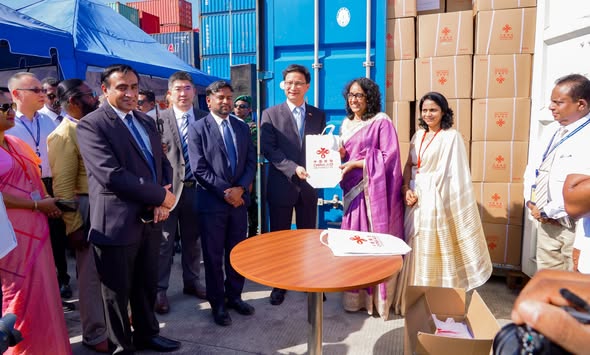
As part of this initiative, the Chinese community has donated school uniform fabric valued at approximately 11.484 million units as a full grant. The materials delivered to Sri Lanka in five shipments. The official handover of the donation was made to the Ministry of Education, Higher Education and Vocational Education by the Ambassador of the People’s Republic of China to Sri Lanka, His Excellency Qi Zhenhong.

It is expected that approximately 4,418,404 students will receive school uniforms this year. Distribution of the materials to Divisional Education Offices was scheduled to begin from January 19, 2026. Free school uniforms will be provided to students in government schools, government-approved Pirivenas, and government-approved Pirivena institutions across the island, under a programme implemented by the Ministry of Education, Higher Education and Vocational Education.

Addressing the event, Ambassador Qi Zhenhong highlighted the long-standing and resilient relationship between China and Sri Lanka, noting that the partnership has endured despite various challenges. He reaffirmed China’s commitment to supporting Sri Lanka’s education sector and contributing to the country’s long-term development.

The event was attended by Deputy Minister of Education and Higher Education Dr. Madura Seneviratne, Secretary to the Ministry of Education Mr. Nalaka Kaluwewa, and several other officials.

Excluding Women from Power is Structural, Not Accidental

At the World Women Davos Agenda 2026, held on January 21 at the World Woman House in Davos-Klosters, Switzerland, on the sidelines of the 56th Annual Meeting of the World Economic Forum, Prime Minister and Minister of Education, Higher Education and Vocational Education, Dr. Harini Amarasuriya delivered a clear and uncompromising message: the exclusion of women from decision-making spaces is not a coincidence, but the result of deeply entrenched gendered power structures.

Her statement challenges a long-standing tendency to frame women’s underrepresentation in leadership as a matter of individual choice, lack of confidence, or insufficient preparation. Instead, it reframes the issue as systemic, rooted in institutions and power-sharing models historically designed around male dominance.

“Women are ignored from the process of enforcing decisions is not a coincidence, it is a result of gender-based actions of power.” In order to create an environment where women can provide leadership with confidence, make changes in organizational and empowerment sharing structures, ” stated the Prime Minister.

This perspective shifts responsibility away from women needing to “fit in” and places it squarely on organizations, governments, and corporate systems that continue to reproduce inequality through their internal structures, norms, and cultures.

The Minister also emphasized that simply increasing the number of women in leadership roles is not enough. Without transforming how power is distributed and exercised, inclusion risks becoming symbolic rather than substantive.

Corporate environments and governance structures often reward conformity to existing leadership models, models that may marginalize collaborative, care-oriented, or inclusive approaches more frequently associated with women leaders. As a result, even when women enter leadership spaces, they may be constrained by systems that were never designed to support their full participation.

Creating an environment where women can lead with confidence, she argued, requires intentional structural change. This includes rethinking decision-making processes, redefining leadership norms, and dismantling informal networks of power that exclude women from influence.

The World Women Davos Agenda 2026 brought together global leaders, policymakers, and advocates to address gender inequality at the highest levels of power. Yet the issues raised resonate far beyond Davos. From corporate boardrooms to public institutions, the same patterns of exclusion persist worldwide.

A Letter to the Version of Me Who Didn’t Make It

Dear You,

I think about you more often than I admit.
The you who tried, who hoped, who stayed up late bargaining with the future. The you who stood at crossroads and picked the path that quietly faded instead of exploding into light.

I want you to know this first: you were not weak!
You were tired. You were learning with bare hands and no map. I remember You carrying dreams bigger than your courage at the time and for that reason, I am proud of you and I should remind you more often than I do that what happened to you, the silence of your hard-work and the storm that never ended that time was never your fault and you were never a failure. You made me the version I am today!

I remember how badly you wanted things to work out your way. How you believed that effort alone should be enough. That every setback felt personal, like proof that you were somehow lacking. I wish I could sit beside you in those moments and tell you what I know now: not everything that doesn’t happen or isn’t going to happen is a loss. Some things simply clear the road and teach you things that no school, no teacher can.

I know You didn’t make it there… but you made Me.
Your disappointments taught me discernment. Your heartbreak taught me boundaries. Your false starts taught me patience. The life I’m living stands on lessons you paid for in full.

I’m sorry you never got to see how strong we became.
Sorry you left thinking you were behind, when really you were laying foundations. Sorry you measured yourself by timelines and self-obsessed people that were never meant for standing next to you.

I want you to remember this.

You were never forgotten.
Your energy was never wasted.
You and your little self were never wrong to hope.

You were necessary!

For I carry you with me, not as regret, but as proof. Proof that I survived what you couldn’t. Proof that growth sometimes looks like letting go. Proof that endings are not the opposite of success; they’re often the doorway to it.

You rest now because I’ve got it from here.
And I promise, I’m living in a way that honors everything you tried to be.

With gratitude,
Me.

Haikus: Dark Mode Collection

Ocean (a day in St Kilda):

Light skies hide behind

dark filters and blue-hued paint.

Three hearts glow orange.

City:

A lone chair

in a car park in a big city

where big buildings rose.

6/12/25:

A ceiling moth watched

yeast rise dark brown and macaroons melt

to the sunset.

Blue Pt.1:

Blue painted me 

as I drove into night blue skies

and neon blue streets.

Blue Pt.2:

We drove miles into

a blue-lit ghost town, where nights

turned to blue sunrise.

7/12/25:

Fog creeps between blinds

engulfing everything in a blur

but the light.

5/12/25:

Alice escaped the room

where people watched her grow.

She found Wonderland.

Cold:

‘Did dinosaurs feel cold

when death creeped on them’

I wondered one cold noon.

Take Me Back:

Could time take me back

like new waves at shore

that wash back to sea, back home.

by Helani Munidasa

Check out her Substack to explore more of her Haikus and other pieces.

ReViveX: When IIT Students Turn Technology into a Path to Better Health

Today, fatigue, stress, and lifestyle-related health issues are becoming the norm but to challenge the issue, a group of IIT students has stepped forward with a refreshing idea: ReViveX, a smart health and vitality-focused solution designed to help people regain balance in their daily lives.

Developed as part of an academic innovation project, ReViveX is rooted in a simple but powerful idea: technology should quietly support human well-being, not complicate it.

What is ReViveX?

ReViveX is a concept-driven digital health solution that focuses on enhancing vitality through smarter lifestyle awareness. Rather than acting as another overwhelming fitness app, the project emphasizes sustainable habits, energy management, and mindful health tracking.

The system is designed to assist users in understanding their daily routines, physical activity patterns, and wellness indicators, encouraging gradual improvements instead of extreme changes. This approach makes ReViveX accessible not only to fitness enthusiasts but also to individuals who are just beginning their health journey.

Why ReViveX Stands Out

What makes ReViveX particularly interesting is its human-centered design philosophy. The project avoids the “one-size-fits-all” mindset and instead promotes adaptability based on individual needs and lifestyles.

Key highlights of the project include:

  • A focus on daily vitality rather than short-term fitness goals
  • Integration of technology with wellness and behavioral awareness
  • A design that encourages long-term habit building
  • Alignment with Sustainable Development Goals (SDGs) related to health and well-being

By combining technical thinking with real-world health challenges, the students have created a solution that feels both practical and forward-looking.

Learning Beyond the Classroom

ReViveX is more than just a project submission; it reflects how young innovators are beginning to approach health technology with empathy and responsibility. Through this work, the students demonstrate the importance of interdisciplinary thinking, blending computer science, sustainability, and wellness into one cohesive idea.

As conversations around preventive health and mindful living continue to grow, student-led innovations like ReViveX remind the world that meaningful change often begins with simple ideas because ReViveX stands as a promising example of how technology, when guided by purpose, can quietly empower healthier lives.

Credits:

This project, ReViveX , was developed by a group of IIT students as part of their academic coursework. All conceptualization, design thinking, and development efforts belong to the student team, and this article serves solely as a knowledge-sharing and publication piece to highlight their work.

Losing Weight When Your Body Is Tired: A Gentle Guide for Adults

For many people in their twenties and thirties, weight gain doesn’t come from overeating alone. It builds quietly, through years of demanding physical labour, skipped meals followed by heavy dinners, sugary soft drinks to push through exhaustion, old injuries that never fully healed, and the unspoken belief that “I’ll worry about my health later.”

Then one day, something happens.
A doctor’s warning. A frightening test result. A moment that makes you pause and realise that your body has been carrying far more than it should.

That’s usually where the real journey begins.

Why Hunger Feels Constant and Why it’s not Your Fault

When someone carries significant excess weight, hunger is often hormonal and metabolic, not a lack of willpower. Years of high sugar intake, especially from soft drinks, train the body to expect quick energy. Refined carbohydrates, white rice eaten in large portions, bakery items, and processed snacks spike blood sugar rapidly and cause it to crash just as fast.

That crash feels like:

  • Sudden hunger
  • Irritability
  • Fatigue
  • Cravings for more sugar

When movement becomes limited due to work or even knee pain, back injuries, or joint damage, the cycle intensifies. The body burns fewer calories, but hunger signals remain loud.

The solution is not eating less, but eating smarter foods that stay with you longer.

Choosing Snacks that Calm Hunger (Low Sodium and easy to eat)

While snacks like fresh fruits, plain curd, and boiled eggs are undeniably healthy and effective for weight loss, they often feel repetitive and uninspiring. When people think about dieting and imagine eating the same few foods every day for weeks or even months, the motivation quickly fades. The diet may be healthy, but the excitement disappears.

The truth is, sustainability matters more than perfection. A diet only works if you can enjoy it long enough to see results.

That’s where creativity comes in.

Below are a selection of simple yet interesting recipes made using the same healthy ingredients but prepared in ways that feel comforting, flavourful, and enjoyable. These recipes are designed to help you stay consistent not just for a few weeks, but potentially for months or even years, without feeling deprived.

Easy, Interesting & Joint-Friendly Recipes for Healthy Weight Loss

1. Creamy Papaya – Curd Breakfast Bowl: Sweet without sugar, filling without heaviness.

You’ll need

  • Ripe papaya (1 cup, diced)
  • Plain low-fat curd (½ cup)
  • A pinch of cinnamon

How to make

Mix everything gently. Chill for 10 minutes if you like it cold.

This tastes like dessert, stabilises blood sugar, and helps curb soda cravings early in the day.

2. Soft Egg & Pumpkin Mash: Comfort food energy with almost no sodium.

You’ll need

  • Pumpkin (1 cup, boiled until very soft)
  • Eggs (2)
  • Black pepper (tiny pinch)
  • Lime juice (optional)

How to make

Mash the pumpkin while warm. Soft-boil the eggs, chop, and fold into the mash. Add pepper and a squeeze of lime.

This feels like a hearty village meal but keeps you full for hours.

3. Savoury Oats with Sri Lankan Flavours: Replaces white rice without feeling “foreign.”

You’ll need

  • Oats (½ cup)
  • Water or low-fat milk
  • Onion (a few slices)
  • Carrot or pumpkin (grated)
  • Turmeric (pinch)

How to make

Cook oats until very soft. Stir in vegetables and turmeric. Simmer until creamy.

This has familiar flavours, zero sauces, very joint-friendly texture.

4. Gotukola & Curd Comfort Blend: Cooling, healing, and extremely filling.

You’ll need

  • Gotukola (finely chopped)
  • Plain curd (½–¾ cup)
  • Lime juice

How to make

Mix everything gently. Let it rest 5 minutes before eating.

This traditional medicine meets modern weight control.

5. Banana-Cinnamon Smooth Comfort Drink: Kills soda cravings instantly.

You’ll need

  • Small ripe banana
  • Plain curd or low-fat milk
  • Cinnamon

How to make

Blend until smooth. Drink slowly.

This is naturally sweet with no crash nor guilt.

6. Soft Vegetable & Egg Soup (No Stock Cubes): Warm, satisfying, and low blood-pressure friendly.

You’ll need

  • Pumpkin, carrot, beans (chopped small)
  • Water
  • Egg (1)
  • Pepper

How to make

Boil vegetables until very soft. Crack egg into soup and stir gently. Add pepper.

7. Pineapple & Curd Afternoon Bowl: Controls evening snacking.

You’ll need

  • Pineapple (small cubes)
  • Plain curd

How to make

Mix and chill slightly.

8. Warm Oats & Papaya Evening Bowl: Calms hunger before dinner.

You’ll need

  • Cooked oats
  • Papaya (soft cubes)
  • Cinnamon

How to make

Mix oats and papaya while warm. Sprinkle cinnamon.

Kerala’s Shocking Truth: Super Educated yet Super Unemployed

Kerala has India’s highest literacy at 96.2%, surpassing or rather beating the national average for literacy rates. Malayalis chase degrees, dream big, and vote left for welfare. Yet, over 25% of educated rural youth and 20% urban grads sit jobless, turning the situation into a paradox of pride and pain.

The Wrong Kind of Smarts

Due to big government spends, Kerala’s schools reach everyone. But Malayalis focus stays on conventional degrees in arts and science for “white-collar” government jobs and with thousands applying for the same public sector spot, job opportunities get drastically unavailable, leading the same thousands of young to settle for lower-paying jobs like peons or janitors. Malayalis strong preference for salaried jobs rather than entrepreneurship is rooted in another kind of reality which really uncovers the effects of having an unhealthy education system as well as a political climate. On one hand, Malayalis who are not self-taught yet excessively drown in unnecessary conventional studies do not possess the kinds of skills that match self-employment. Their educated grads twiddle thumbs while factories beg for workers.

Educated Unemployment

This educated unemployment has become a serious test of Kerala’s development. As a result of constantly struggling to create enough suitable jobs, a large numbers of Malayalis migrated abroad, especially to Gulf countries, in search of better employment opportunities. Over time, the “Gulf Malayali” became a familiar figure in Kerala’s social and cultural life and was often viewed as financially stable and highly desirable.

The theatrical release movie poster for the 2015 Malayalam film ‘Pathemari’, that depicts the socio-economic struggles of the Gulf Malayali. Image credits: The Kerala Paradox: From High Literacy to High Educated Unemployment

The Kerala- Gulf diaspora, numbering over two million people, has played a major role in the state’s economy. In 2019 alone, remittances from abroad brought in nearly $14–15 billion, boosting household income, consumption, and savings, and contributing significantly to economic growth. However, this migration also created a shortage of local workers in low-skilled sectors such as construction and coconut harvesting. These jobs are now largely filled by migrant workers from North-Eastern Indian states. This balance between skilled emigration and migrant labour inflow has become a key feature of Kerala’s economic development. But in the wake of oil crashes, visa cuts, and COVID slashing over 300,000 jobs since 2013, the Malayali’s diaspora’s dream has been fading. Then unemployment started hitting 26.5% as of May 2020 and now returning grads face empty promises with no high-skill gigs waiting.

Despite these rates, a gender gap in literacy seemingly continues to persist across India. Men consistently show higher literacy levels than women, reflecting long-standing social and economic inequalities in access to education. In states like Kerala, this gap is much smaller due to strong investments in education, but women still fall just behind men. In contrast, states with lower literacy levels show much wider differences, with far fewer women able to access basic education. This highlights that while progress has been made, achieving true gender equality in education remains an ongoing challenge. This in fact underlines the need for continued policy focus on gender equality in education.

Sources:

  • Mathrubhumi News, 2019.
  • The Kerala Paradox: From High Literacy to High Educated Unemployment
  • At 96.2%, Kerala tops literacy rate chart; Andhra Pradesh worst performer at 66.4%

DARKNESS

You were able to surrender me
Under the coldness that I loathed
Chilling every pore of mine.You let me go blind nervously,
Abandoning me
Inside you
When I was a child.But now,
I embrace that iciness,
I get myself enveloped cozily
In that same frostiness
Trying to find solutions
Seeking through you
For the darkest days
Denser than you
Without letting me go blind
To heal my tormenting self.

Poem by Prabashi Munipura.

If this poem resonated with you, take a moment to sit with it or share it with someone who might understand because growing up and learning to embrace emotional coldness is a quiet yet powerful sign of resilience and it should never go unnoticed.

සෑ ගිරිය___

සෑ ගිරිය ලස්සනට
එකම එක දවසකදි
මං දුටු වා
එදා ඒ පොසොන් සඳ
විතරමයි කළ එළිය
කල එළිය……..

වෙන මොනව කියන්නද
තෙරුවන් සරණයි
ලං. වි. ම. ට
වැඩ වරා සිටි හෙයින්
එදවසට………..

ආගම නෑ ඒ දවසට
මට බාධා කළේ
සොබා දහම බුදුවෙනු රඟ
දුටුමි අහස් තලේ
තෘෂ්ණාවෙන් බැබලි බැබලි
නොයිද ගිමන් හලේ
ආයේ එහෙම කවදානම්
දකිම් මිහින්තලේ…….

ගාමිණී රුබේරු.