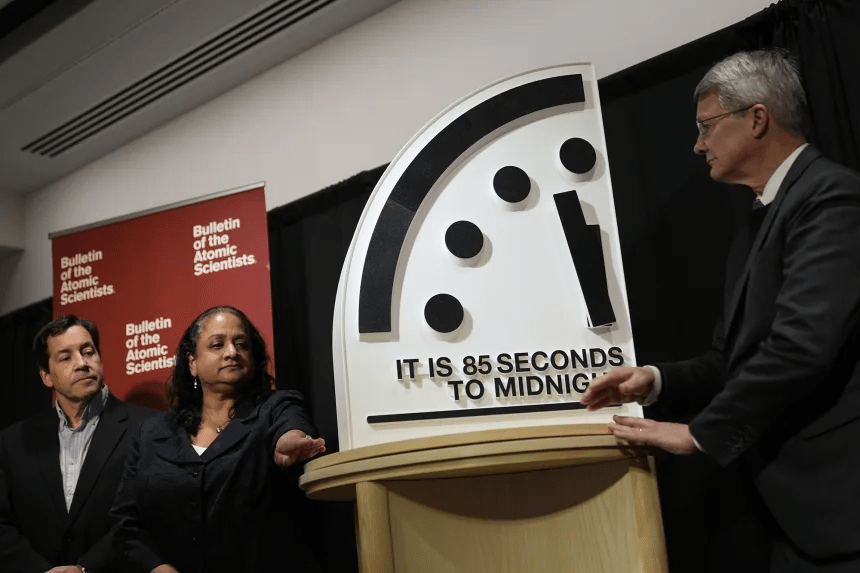
The Doomsday Clock has been set to 85 seconds to midnight which is the closest it’s ever been since it was introduced in 1947, signaling rising global risks and existential threats.
Let’s get into simple terms. The Doomsday Clock isn’t a countdown timer in the usual sense because it doesn’t tick down in real time like the usual clocks do and it doesn’t precisely predict the moment the world will end. But when scientists say we are 85 seconds to midnight, it is hard not to pause and feel uneasy.
What does the midnight represent? Midnight in this case represents global catastrophe or a point where human-made threats like war, climate collapse, technology and pandemics overwhelm our entire abilities to control them. What’s more concerning is that being this close has never happened before. According to the scientists behind the Doomsday Clock, we are closer to disaster than any point in modern history.
This 85 seconds is symbolic and not literal. It doesn’t mean that the world ends in 85 seconds; rather it represents how compressed the margin for error has become. In simple terms, we no longer have the luxury of time to reverse our mistakes. We had time before, but now, we don’t anymore.
One reason the clock moved closer this year, 2026, is because, as experts have pointed out, a dangerous mix of problems is occurring all at once. This is indeed true because today, nuclear tensions remain as high as ever (especially with diplomatic trust becoming more fragile), climate change is advancing rapidly, biological risks including pandemics remain a real threat almost every day and international cooperation is weakening, particularly when it is needed the most.
These not only say that individually, these risks are serious but also together, they amplify each other.
This clock is not saying, “it’s over.” But it’s definitely saying, “this is the moment to act.” The closer the clock gets to midnight, the louder the warning becomes. The scientists state that it is possible to move the clock back but it solely depends on human choice rather than fate.
We may not know how soon things could unravel but one thing is sure now: the time to fix what’s broken is now, not later.
Sources: Doomsday Clock 2026: Scientists set new time
Want to find out how technology has rewritten childhood? Read:
 Acadora