
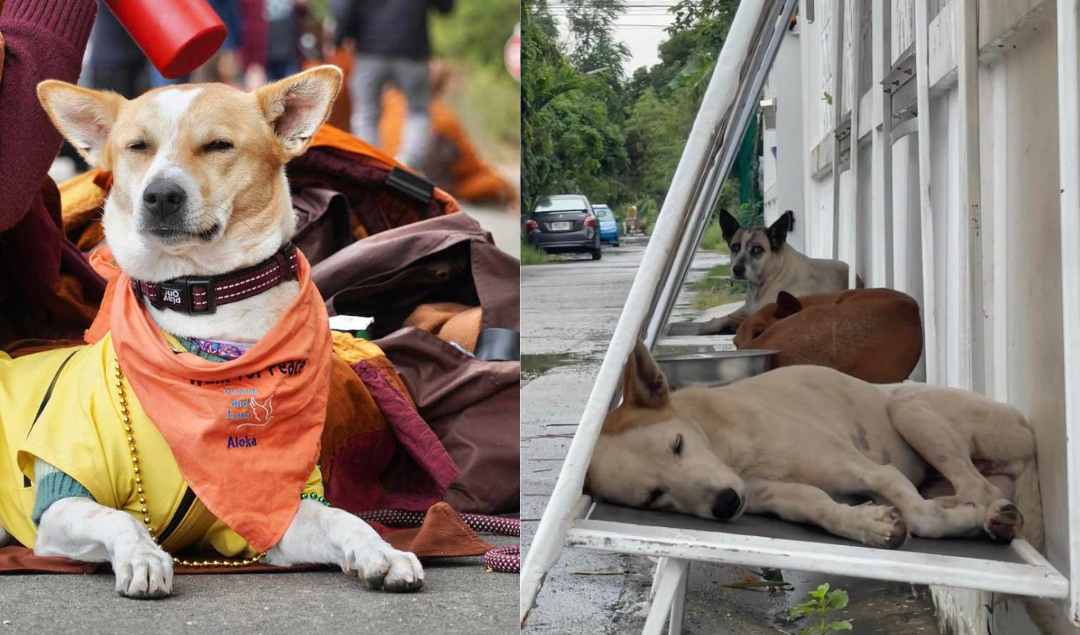
Aloka, the stray dog who walks alongside Buddhist monks on the ‘Ehipassiko’ Global Walk for Peace, has captured hearts across countries. His story shows how a once-struggling street dog transformed his life through compassion, care, and a chance encounter. Today, Aloka has become a symbol of resilience, kindness, and most importantly the belief that every living being deserves dignity.
Yet, does now-Aloka truly represent the reality of other street dogs and even cats? Or does his story expose a quieter, grimmer, and more horrifying truth about the millions of other street animals still living and dying unnoticed on the streets?
Sri Lanka is often regarded as a nation rooted in religion and piety. However, for many Sri Lankans, street cats, dogs and other animals are nuisances rather than living beings. When it comes to compassion and empathy, the very people who boast about or uphold the precept of abstaining from harming living beings often turn a blind eye.
Ironically, Aloka received flowers, admiration and smiles on the same streets where other dogs are frowned upon, stoned or even doused with hot water.
Although there is no exact official estimate, Sri Lanka is believed to be home to between 1–2 million street dogs with some estimates going even higher. This number continues to grow as hundreds of puppies are born on the streets and as irresponsible pet owners abandon their animals in random public places. These animals face hunger, neglect, and violence which reveals that this is not just a lack of resources but a deeper lack of empathy.
Aloka himself could have easily been another victim of abuse, neglect, hunger and malnutrition because most street animals survive on garbage or occasional handouts, leaving them with weakened immune systems. Recent news circulated around diseases like rabies have only worsened this situation. People only mistreat them more. Yet, many of these conditions like rabies, mange, tick fever, and infections could be controlled if the government, funding programmes and communities worked together toward real solutions.
Instead, neglect has increased and compassion has faded.
Street animals are hit by vehicles and left injured on roadsides without help every year. Some are beaten or poisoned and it is deeply troubling that in a country that values mental purity, such basic acts of kindness remain inconsistent.
This is not just an animal issue. It reflects the irresponsibility, cruelty, and indifference within society itself. Because there are solutions. People can work with local animal welfare groups, help rescue and transport animals to clinics, support funding efforts and sponsor sterilization programs. This change does not require a lot of money. Even a small portion of what we spend on non-essentials could make a difference.
Adoption is another powerful step. Many street dogs and cats are healthy, loyal and highly adaptable. Instead of buying pets, why not adopt one? Giving one animal a home can change its entire life and may be shift attitudes in society.
Equally important is awareness. People can educate communities, challenging animal cruelty. Staying silent can only allow abuse to continue. Stronger public action can push for better enforcement of animal welfare laws as well. The problem lies no on these animals are but on this system and human behavior.
What happens to street dogs today and even during this peace walk is not the fault of Aloka or the Buddhist monks. The attention given to them in this article is only meant to highlight the contrast between genuine compassion and fake, preformative piety. The monks walk mindfully alongside Aloka, showing care in every step they take. Yet one question remains unanswered:
Do the people who admire them truly understand what that compassion means?

