3 Smart Moves Every Student Should Make Before Their Final Year

For many students, the final year of the university feels overwhelming. Exams pile up, expectations rise, and suddenly the question: What’s next? arises. What often gets overlooked is that the most important decisions aren’t made in the final year itself, but in the time leading up to it.

Students who plan early don’t just reduce stress; they create options. These three smart moves can help you step into your final year feeling prepared, confident, and ahead of the curve.

The first move is learning to track opportunities early, rather than waiting until things feel urgent. Scholarships, internships, exchange programs, and grants usually open months in advance, and many students miss them simply because they start looking too late. By the time deadlines arrive, it’s already too late to gather documents, improve qualifications, or meet eligibility requirements.

When you begin paying attention early, you give yourself time. Time to prepare applications properly, time to improve your profile, and time to make informed decisions instead of rushed ones. This is why following reliable education platforms and staying aware of what’s available can quietly shape your future. Opportunity doesn’t always come loudly, sometimes it passes by unless you’re paying attention.

The second move is building a future-ready CV before you think you need one. Many students believe a CV is something you prepare only after graduation, once you have achievements worth showing. In reality, your CV grows alongside you. It reflects your effort, curiosity, and willingness to learn, not just your final results.

Even before your final year, your experiences already matter. Academic projects, volunteering, online learning, student initiatives, writing, research, or even managing a small personal project all show initiative. A future-ready CV tells decision-makers that you didn’t wait passively for success, you worked toward it. This mindset matters just as much as grades.

The third move is learning at least one practical skill that your classroom may not teach you. While formal education focuses heavily on exams and syllabi, real-world opportunities often depend on skills learned outside traditional lessons. Writing clearly, communicating confidently, using digital tools effectively or understanding how to research and think critically can give you a serious edge.

You don’t need to master everything. Choosing one skill and improving it steadily before your final year can make a noticeable difference in applications, interviews, and academic work. These skills don’t just help you after graduation; they support you throughout your studies.

Your final year should not be about scrambling to catch up. It should be a transition into the next phase of your life with clarity and confidence. Students who succeed aren’t always the ones with perfect results; they’re the ones who planned earlier and made thoughtful choices along the way.

Related Reads:

Discover Scholarships You Didn’t Know Existed!

1. Australia Awards Scholarships (Fully Funded)

Australia Awards Scholarships are prestigious fully funded scholarships offered by the Australian Government (Department of Foreign Affairs and Trade) to students from eligible developing countries. These awards are designed to support long‑term study (undergraduate or postgraduate) in Australia and build skills to contribute to development in the recipients’ home countries.

What’s included:

  • Full tuition fees paid
  • Return economy‑class airfare
  • Living allowance (fortnightly stipend)
  • Establishment payment for accommodation/study materials
  • Health insurance (Overseas Student Health Cover)
  • Pre‑course English training (if needed)
  • Academic support & fieldwork assistance (for research students)

Application timeline:

2027 intake applications opened 1 Feb 2026 and close 30 April 2026 (check exact times for your country). Applicants must submit through the official Australia Awards portal (OASIS).

Who can apply:

Citizens of participating developing countries in the Indo‑Pacific region who want to pursue full‑time study in Australia in fields that support their country’s development goals.

Specific eligibility and deadlines vary by country.

Important: Visit the official page for the scholarship: Australia Awards Scholarships

2. Master Mind Scholarships (Flanders & Brussels, Belgium)

The Master Mind Scholarship is awarded by the Flemish Ministry of Education and Training to outstanding international students who want to pursue a master’s degree at a university or higher education institution in Flanders or Brussels (Belgium, part of Europe).

Scholarship Benefits

  • Grant of about €10,225 per academic year
  • Full tuition fee waiver at participating institutions
  • Scholarship supports one or two academic years depending on your master’s programme length (60 ECTS = 1 year; 120 ECTS = 2 years).

Who Can Apply (Eligibility)

  • You must be applying for a master’s programme at a Flemish higher education institution.
  • High academic performance, usually a GPA of around 3.5/4.0 or equivalent.
  • Proof of English proficiency (like IELTS or TOEFL) is required.
  • You must be accepted by the host university first to be considered for the scholarship.
  • All nationalities are eligible, including Sri Lankan students, but Russian citizens are excluded this year.
  • You cannot already be enrolled in a Flemish university (unless in a preparatory course).

Timeline & Process

  • The call for academic year 2026–2027 is now open.
  • You generally apply to your chosen university first before the institution nominates you for the scholarship.
  • Deadlines vary by university, often between Feb–Apr each year.

Important: Visit the official page for the scholarship: Master Mind Scholarship

3. Science@Leuven Scholarship (KU Leuven, Belgium)

The Science@Leuven Scholarship is a prestigious academic award offered by the Faculty of Science at KU Leuven to support outstanding international students who want to pursue a Master’s degree in selected science programmes at KU Leuven. It’s designed to attract top talent from around the world.

Who can apply:

International students of any nationality (including Sri Lankan students), you just need to meet the eligibility requirements and be applying for a qualifying Master’s programme at KU Leuven.

Eligible Master’s fields include:

  • Astronomy & Astrophysics
  • Biology
  • Biophysics, Biochemistry & Biotechnology
  • Chemistry
  • Mathematics
  • Physics
  • Statistics & Data Science
  • Sustainable Development
  • (Some fields may have specific conditions.)

Scholarship benefits:

  • €12,000 allowance per academic year (up to two years) to help with living costs.
  • Partial tuition fee reduction – for non‑EEA students, the remaining tuition fee can be significantly reduced (e.g., around €3,252.72 in 2026–27).

Application timeline:

  • Applications open: typically 1 October 2025
  • Deadline: 15 February 2026
  • To apply for the scholarship, you first apply for the Master’s programme, then include your admissions confirmation when submitting the scholarship application.

Basic eligibility requirements:

  • A Bachelor’s degree from a non‑Belgian institution
  • High academic performance comparable to Distinction
  • Strong English proficiency (e.g., IELTS 7.0 / TOEFL iBT 94+)
  • Motivation and letters of recommendation from professors
  • No previous Master’s or study/work experience at KU Leuven

Important: Visit the official page for the scholarship: Science@Leuven Scholarships

4. International Master’s Scholarships – Université Paris‑Saclay (France)

The International Master’s Scholarships programme at Université Paris‑Saclay in France supports outstanding international students (including Sri Lankan citizens) who want to pursue a Master’s degree at one of the university’s member institutions. All academic fields are eligible, and the scholarship encourages highly‑qualified students to join research‑oriented or regular Master’s programmes.

Eligibility

  • You must be a foreign national (non‑French) admitted to a Master’s programme at Université Paris‑Saclay before the scholarship deadline.
  • You must be under 30 years old in the year of application.
  • You should be enrolling in France for the first time in higher education (exceptions exist for certain short stays, language courses, or mobility exchanges).
  • You must not receive other funding exceeding €600/month (including other scholarships like Erasmus Mundus or France Excellence).

Sri Lankan students qualify as international applicants as long as they meet the criteria above and are admitted to a Master’s programme.

Scholarship Benefits

  • €10,000 per year (paid monthly for ~10 months of the academic year) to support living costs.
  • Up to €900 travel and visa support depending on your country of origin.
  • Scholarships are awarded for 1 year (M2) or 2 years (M1 + M2 with continuation).

Application Timing (Academic Year 2026–2027)

  • The deadline to be selected by your Master’s programme coordinator is 25 March 2026.
  • After being selected by the programme, the deadline to submit the scholarship application is 31 March 2026.
  • Results are expected mid‑May 2026.

Important: Visit the official page for the scholarship: International Master’s Scholarships Program

5. World Bank – JJ/WBGSP Scholarship (Joint Japan/World Bank Graduate Scholarship Program)

The JJ/WBGSP is a fully funded international scholarship for mid‑career professionals from developing countries who want to pursue a Master’s degree in development‑related fields at selected universities around the world.

Sri Lankan Eligibility

  • Sri Lanka is included on the list of eligible developing country nationals who can apply.
  • Applicants must not hold dual citizenship of any developed country.
  • You must be admitted unconditionally (except for funding) to one of the 44 participating master’s programmes before applying.
  • You must have at least 3 years of paid, development‑related work experience after your Bachelor’s degree, acquired within the past six years, and be currently employed full‑time in development‑related work.

This means recent graduates cannot apply immediately unless they have three years of relevant full‑time work experience.

Scholarship Benefits

JJ/WBGSP provides a strong financial package covering:

  • Full tuition fees for your master’s programme
  • Monthly living stipend to cover accommodation and daily costs
  • Round‑trip economy airfare between Sri Lanka and the host country
  • Health insurance through the university
  • Travel allowance (e.g., US $600 for departure and return)

These benefits typically cover up to 2 years of study or the duration of the programme, whichever is shorter.

Application Timelines (2026 Cycle)

There are two application windows for the 2026 cycle:

  • Window 1: January 15 – February 27, 2026
  • Window 2: March 30 – May 29, 2026

To apply, you must receive an unconditional admission offer to a participating master’s programme before submitting the scholarship application.

Post‑Study Commitment

If selected, scholars are expected to return to their home country after studies to use their skills toward national development.

Important: Visit the official page for the scholarship: World Bank Scholarships Program

Disclaimer / Note for Readers:

All scholarship details shared here are for informational purposes. Before applying, please visit the official scholarship websites to confirm eligibility, deadlines, and requirements. Links to official sources are included in each post. This ensures you have the most accurate and up-to-date information.


Degrees for Sale: How Sri Lanka’s Degrees are Turning into Merchandise

For decades, a university degree in Sri Lanka symbolised discipline, sacrifice, and intellectual achievement. It was something earned through sleepless nights, relentless exams, and years of academic struggle. Today, that meaning is quietly eroding. Behind campus gates and official ceremonies, an uncomfortable reality is taking shape: degrees are increasingly treated as transactions, not achievements.

This is not about a few dishonest students cutting corners. It is about a system slowly bending under pressure, where academic integrity is compromised, standards are diluted, and credentials are sometimes obtained without genuine scholarship. When education becomes a shortcut rather than a process, the damage goes far beyond individual universities.

When qualifications matter more than knowledge

Sri Lanka’s education system has long been praised for producing capable professionals despite limited resources. Yet the growing obsession with titles, Dr., Prof., MBA, PhD, has created a culture where the label matters more than the learning behind it.

In some academic and professional circles, advancement depends less on research quality or teaching ability and more on possessing the “right” degree. This pressure fuels an underground economy of academic misconduct: outsourced theses, copied research, questionable foreign affiliations, and degrees obtained with minimal academic engagement. When credentials become currency, learning becomes optional.

The rise of academic shortcuts

What was once whispered is now openly discussed. Students speak of thesis-writing services operating in plain sight. Research is recycled, paraphrased, or purchased. Supervisory oversight is often weak, overstretched, or compromised. In extreme cases, allegations surface of degrees awarded through influence rather than evaluation.

This environment does not emerge by accident. It thrives when accountability is weak and enforcement is selective. Universities are pressured to produce graduates quickly. Lecturers are burdened with excessive workloads. Regulatory bodies move slowly or not at all. The result is a system where appearance replaces substance

The greatest victims are of this issue are not the dishonest few who exploit loopholes, but the honest many who still believe in merit. Students who genuinely work hard find their qualifications devalued. Employers grow skeptical, increasingly relying on foreign certifications or private assessments to judge competence.

More dangerously, society bears the long-term cost. When unqualified individuals occupy positions in education, healthcare, engineering, or governance, the consequences are real, poor decisions, weakened institutions, and declining public trust.

A degree without knowledge is not harmless. It is risky.

This is not an attack on higher education. It is a warning. Sri Lanka’s universities remain home to brilliant students and dedicated academics who uphold standards despite the odds. But their efforts are undermined when the system allows degrees to be bought, borrowed, or fast-tracked without merit.

If education loses its credibility, rebuilding it will take generations.

Related Reads:

Make Your Research Cinematic and Let It Defend Itself

For many research students, the biggest challenge is not conducting research, but communicating it clearly. Strong findings can lose their impact if they are presented in a way that feels confusing, distant, or overly technical for observers.

One effective way to avoid this is by using storytelling techniques in academic communication. This does not mean exaggeration or simplification of facts. Instead, it is about structure, clarity, and engagement.

Why Storytelling Matters in Research

Research is often shared with audiences beyond your supervisor. Audiences such as conference attendees, reviewers, policymakers, journalists, and the public are more likely to understand and remember your work when it follows a clear narrative and having a clear narrative will help you:

  • Clarify your research purpose
  • Show the importance of your research problem
  • Guide readers logically through your work
  • Make complex ideas easier to follow

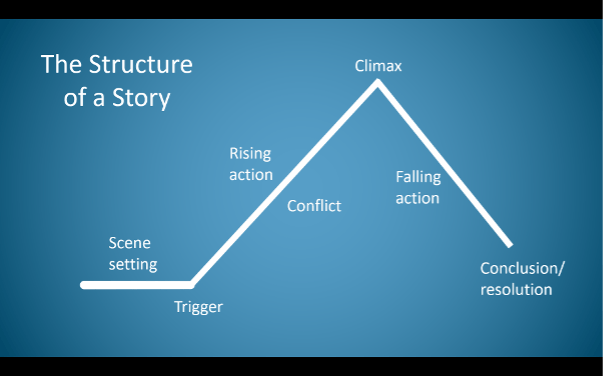
Most successful research papers already follow a story-like structure, even if we do not always recognize it. You can think of your research as having the Classic Story Arc.

A strong story has:

  • Scene-setting: Where are we? What’s the context?

  • Trigger: What problem kicked things off?

  • Rising Action: The hard work: experiments, challenges, data collection.

  • Conflict: What got in your way? Tough data? Unexpected results?

  • Climax: Your breakthrough moment.

  • Resolution: What your findings mean for the world.

Image credits: Turn your research into a Hollywood-worthy story

This arc fits any research field: your literature review is the setup, methodology and data collection become the adventure, and your conclusions are the satisfying finish.

Viewing your research this way can help you explain it more confidently and coherently and ultimately will help the audience grasp a clear idea.

In order for this to work, you should keep your language simple and not complicated. Using complex language does not make research stronger. Clear writing shows clear thinking. While technical terms are sometimes necessary, they should be used carefully and explained when possible.

That said, it is necessary to ditch academic jargon because only straight-forward language can help anyone follow your story and make them curious to know what will happen next.

You can ask these questions yourself to understand this more:

  • Would a student from another discipline understand this section?
  • Can this sentence be shorter or more direct?

If you think this way, your research’s clarity will increase both its accessibility and credibility.

Storytelling is especially useful when:

  • Writing conference abstracts
  • Preparing presentations
  • Explaining your research to non-experts
  • Writing blog posts or summaries about your work

A well-told research story makes your work easier to share, publish, and promote.

Learning to frame your research as a structured story does not reduce or cheapen its academic value. Instead, it amplifies its impact and ultimately helps your ideas travel further and reach the audiences they deserve. For research students, storytelling is not an optional skill, it is a powerful tool for academic success. So make sure you grab your audience from the first line and take them on a research journey worth remembering.

Sources: Turn your research into a Hollywood-worthy story