
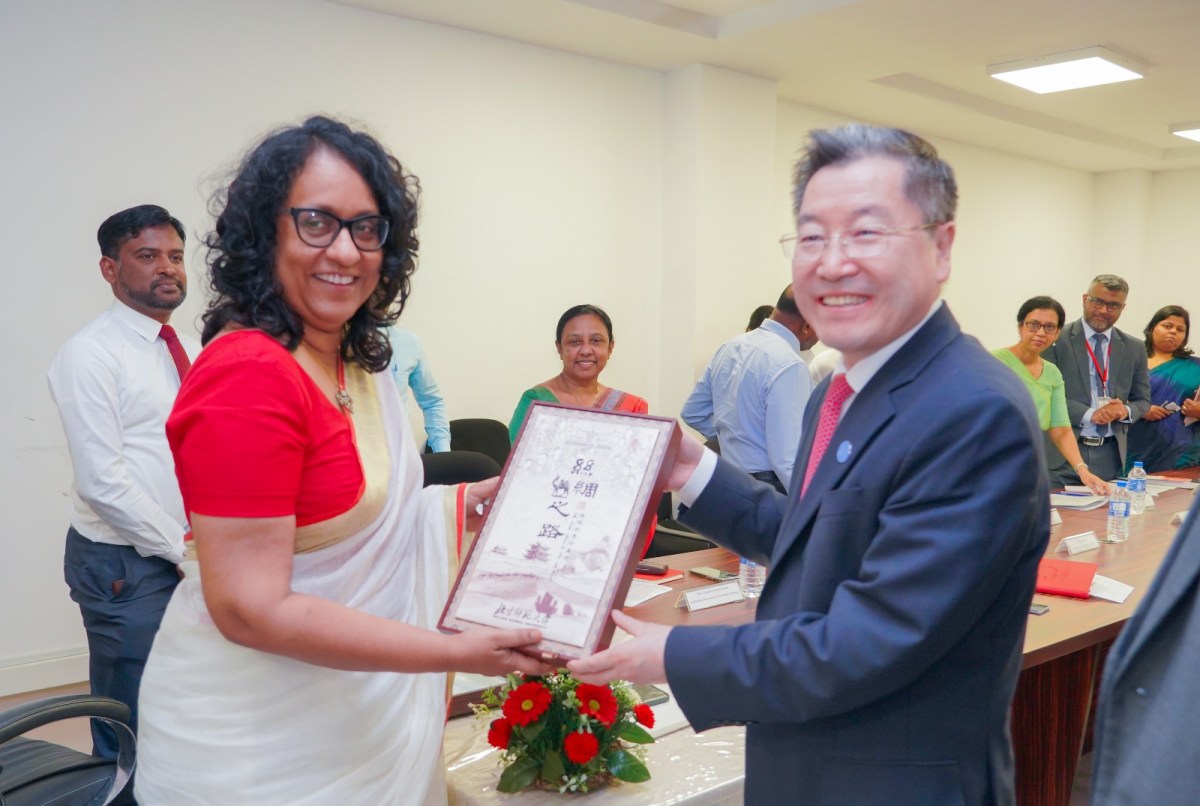
Speaking during a discussion held recently at the Ministry of Education with representatives from Huawei Technologies and the UNESCO International Research and Training Centre for Rural Education (UNESCO-INRULED), the Prime Minister Dr. Harini Amarasuriya emphasized the need to use foreign educational assistance in the most effective manner for the wellbeing of students.
She stated that the Ministry of Education and the Digitalisation Task Force should jointly launch a coordinated programme to ensure that digital equipment, including interactive display panels required for smart classrooms, is distributed systematically and equitably among schools. Special attention, as she noted, must be given to rural areas to reduce educational disparities.
This evidently signals a clear intention to modernise classrooms, particularly in rural areas. Interactive screens, smart classroom tools, and teacher training programmes are being positioned as key solutions to bridge long-standing educational gaps. On paper, it sounds like progress. But an important question remains: are digital tools what Sri Lankan classrooms need most right now?
There is little doubt that technology can enhance learning when used thoughtfully. Interactive displays can make lessons more engaging, digital content can widen exposure, and trained teachers can use technology to explain complex concepts more effectively. For rural schools that have long been under-resourced, such initiatives also represent recognition and long-overdue attention.
Yet, the reality inside many classrooms tells a more complicated story.
Across the country, thousands of students still struggle with basic access to textbooks, libraries, and reading materials. In some schools, book shortages persist and reading corners are nonexistent. For younger students especially, foundational learning depends less on screens and more on books they can hold, reread, annotate, and truly engage with because literacy, comprehension, and critical thinking are still built page by page.
This raises a critical concern: does introducing advanced digital equipment risk addressing the future before securing the basics?
Digital tools are only as effective as the systems that support them. Maintenance, internet access, and trained teachers and technical staff are not evenly available across schools. Even with teacher training underway, the long-term sustainability of smart classrooms depends on continuous funding, technical support, and clear usage policies. The education system is still learning to manage these challenges.
The government’s emphasis on child safety frameworks and age-appropriate digital use is a welcome and necessary step. It acknowledges global concerns around screen time, distraction, and digital dependency. Still, regulation alone cannot replace the deep learning that comes from quiet reading, sustained attention, and access to quality printed material.
This does not mean Sri Lanka should turn away from digitalisation. Rather, it suggests the need for balance. Technology should complement education, not overshadow its foundations. A smart classroom without books risks becoming a visually impressive space that lacks depth. Conversely, a classroom rich in books but supported by selective, purposeful technology may offer students the best of both worlds.
As foreign-funded digital initiatives move forward, policymakers may need to ask a simpler, student-centred question:
Are we building classrooms that look modern or classrooms that help children learn better?
True educational progress may lie not in choosing between screens and books, but in ensuring that every child and teacher first has access to the essentials, before being introduced to the extras.

 Acadora