

For many research students, the biggest challenge is not conducting research, but communicating it clearly. Strong findings can lose their impact if they are presented in a way that feels confusing, distant, or overly technical for observers.
One effective way to avoid this is by using storytelling techniques in academic communication. This does not mean exaggeration or simplification of facts. Instead, it is about structure, clarity, and engagement.
Why Storytelling Matters in Research
Research is often shared with audiences beyond your supervisor. Audiences such as conference attendees, reviewers, policymakers, journalists, and the public are more likely to understand and remember your work when it follows a clear narrative and having a clear narrative will help you:
- Clarify your research purpose
- Show the importance of your research problem
- Guide readers logically through your work
- Make complex ideas easier to follow
Most successful research papers already follow a story-like structure, even if we do not always recognize it. You can think of your research as having the Classic Story Arc.
A strong story has:
- Scene-setting: Where are we? What’s the context?
- Trigger: What problem kicked things off?
- Rising Action: The hard work: experiments, challenges, data collection.
- Conflict: What got in your way? Tough data? Unexpected results?
- Climax: Your breakthrough moment.
- Resolution: What your findings mean for the world.
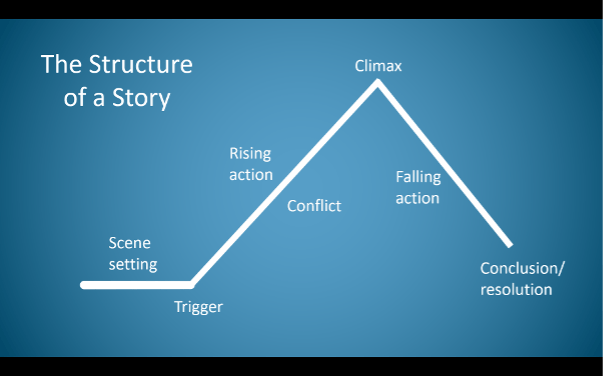
This arc fits any research field: your literature review is the setup, methodology and data collection become the adventure, and your conclusions are the satisfying finish.
Viewing your research this way can help you explain it more confidently and coherently and ultimately will help the audience grasp a clear idea.
In order for this to work, you should keep your language simple and not complicated. Using complex language does not make research stronger. Clear writing shows clear thinking. While technical terms are sometimes necessary, they should be used carefully and explained when possible.
That said, it is necessary to ditch academic jargon because only straight-forward language can help anyone follow your story and make them curious to know what will happen next.
You can ask these questions yourself to understand this more:
- Would a student from another discipline understand this section?
- Can this sentence be shorter or more direct?
If you think this way, your research’s clarity will increase both its accessibility and credibility.
Storytelling is especially useful when:
- Writing conference abstracts
- Preparing presentations
- Explaining your research to non-experts
- Writing blog posts or summaries about your work
A well-told research story makes your work easier to share, publish, and promote.
Learning to frame your research as a structured story does not reduce or cheapen its academic value. Instead, it amplifies its impact and ultimately helps your ideas travel further and reach the audiences they deserve. For research students, storytelling is not an optional skill, it is a powerful tool for academic success. So make sure you grab your audience from the first line and take them on a research journey worth remembering.
 Acadora