
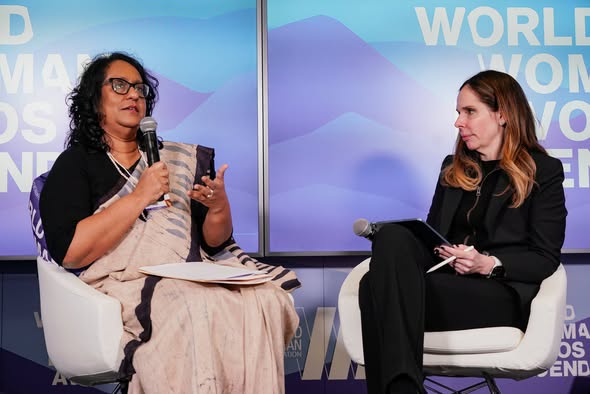
At the World Women Davos Agenda 2026, held on January 21 at the World Woman House in Davos-Klosters, Switzerland, on the sidelines of the 56th Annual Meeting of the World Economic Forum, Prime Minister and Minister of Education, Higher Education and Vocational Education, Dr. Harini Amarasuriya delivered a clear and uncompromising message: the exclusion of women from decision-making spaces is not a coincidence, but the result of deeply entrenched gendered power structures.
Her statement challenges a long-standing tendency to frame women’s underrepresentation in leadership as a matter of individual choice, lack of confidence, or insufficient preparation. Instead, it reframes the issue as systemic, rooted in institutions and power-sharing models historically designed around male dominance.
“Women are ignored from the process of enforcing decisions is not a coincidence, it is a result of gender-based actions of power.” In order to create an environment where women can provide leadership with confidence, make changes in organizational and empowerment sharing structures, ” stated the Prime Minister.
This perspective shifts responsibility away from women needing to “fit in” and places it squarely on organizations, governments, and corporate systems that continue to reproduce inequality through their internal structures, norms, and cultures.
The Minister also emphasized that simply increasing the number of women in leadership roles is not enough. Without transforming how power is distributed and exercised, inclusion risks becoming symbolic rather than substantive.
Corporate environments and governance structures often reward conformity to existing leadership models, models that may marginalize collaborative, care-oriented, or inclusive approaches more frequently associated with women leaders. As a result, even when women enter leadership spaces, they may be constrained by systems that were never designed to support their full participation.
Creating an environment where women can lead with confidence, she argued, requires intentional structural change. This includes rethinking decision-making processes, redefining leadership norms, and dismantling informal networks of power that exclude women from influence.
The World Women Davos Agenda 2026 brought together global leaders, policymakers, and advocates to address gender inequality at the highest levels of power. Yet the issues raised resonate far beyond Davos. From corporate boardrooms to public institutions, the same patterns of exclusion persist worldwide.
 Acadora